Did know very much about the Windrush?
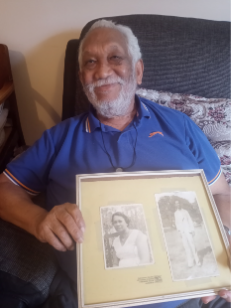
No, but I know of the people, most of the people, that was growing away at that time because that time we were able to go on and off the boat, you know. When I came to England, it was in May 1958. I arrived in Southampton in June 1958. Well, that’s a long story. When I came to England, I came to my sister’s home in Stockwell and at that time, life was not very good in England. There was a lot of racial riots, work and everything that’s going on. So, I did work, but I didn’t join the RAF straight away. I went to a recruiting place in London, and I took different what do you call it, information and that was in August 1958. And then I ended up being called.
I went to my perfect coaching area; it was in RAF Cardington and from Cardington I spent a week got fitted in uniform and then was sent to a place called Wilmslow and I did ten weeks training at Wilmslow. I joined. Ten weeks training in Wilmslow. I went to Wilmslow and saw a place called RAF Alton in Wendover. That was even 1959. I was about 24, 25. I was married at the age of 22 in Jamaica. I came over in 58 and then in 59 my wife joined me.
I came on the Boat, there were two thousand Jamaicans on the boat called Vigoda. The boat stopped at several places. It stopped at the first one, it stopped at a Spanish island, I can’t remember the name. Saint Lucia, Antigua and I think Barbados and every time we stopped, we’d take more on and more people on. We had two thousand Jamaicans. It was from Kingston, Jamaica. Two thousand Jamaicans on a Vigoda and it took 16 days, and it stopped at four different islands.
Did you stop at any other countries before arriving in England?
No, We had to stop and take people and then from there we’d go along. We spent 16 days travelling to Southampton.
What were the conditions like? Did you have your own cabin?
No, no, no. It was an immigration boat. We had, what do you call it, a cabin? And we travelled in the cabin. It was six of us in a room. Just terrible, terrible, terrible. Can you imagine all the different nationalities? Drinking and fighting and everything. It was an experience. I was glad to get out, it was a mixture, some Spanish people too. It was a mixture of black and white and other nationalities. It was a complete mixture. It was a mixture of men and women, and some were together, it was single women and single men and couples. There was music every day, drinking every day and floating.
We did come up on a Spanish island and we stopped, we came up in the morning and then we left again at night. We managed to walk around the island and meet people and then got back on the boat in the evening. Actually, there were a few black people living there and they were speaking Spanish, I guess. Well, I didn’t speak to them. I don’t know. Yeah, but they were speaking to their own families. People were coming on that boat and people getting off the boat. Yeah.
So, what made you decide to come to England? What was the inspiration of coming here?
Well, the thing about coming to England is that everybody wants to get rich. And they approach you with the idea that England has the streets filled with gold and then all the families kept going and friends were going. During the war there were quite a number of people that they took from Jamaica to the war and after the war, they all came back with white wives. You understand? They mixed us with the mixture, so we kept writing and people were coming and people going, and it was strange.
I’m from West Kingston. You must have heard my name is Toyloy. The thing is my side of the story is totally different from a lot of the people because let’s start with my father. My father is Japanese and his best parents, they were from Japan, right? And they all came to Jamaica. Four brothers of Toyloy came to Jamaica 600 years ago when the British had captured it from the Spanish and they became permanent up to now, right? And they turned, very black women, Japanese-wise black multiply. That’s the good black, that’s the father’s side. Now my mother’s side, my mother’s father is Chinese, right? And he was born in Hong Kong, and he came to Jamaica to teach the Chinese in Jamaica, English.
And he in turn married a black Jamaican, right? And then my mother and father get together, got married and in turn, their brother and sister also married. So, two brothers married two sisters, and they were Chinese and Japanese, I can’t tell you nothing about Japan and I can’t tell you nothing about Hong Kong because I remember by the time I left Jamaica at the age of 24 I didn’t learn much. I knew the immediate the family that I met before I left Jamaica. When I came to England, there was a kind of a spread of my name is Toyloy, and they were everywhere meeting aunts and cousins all over England. Then when I travelled to America, I met so many in America, so the Toyloy family is everywhere, you see. I felt so welcomed when I came here, do you know what I mean? Although there was a lot of racialism, everybody fighting, all the whites beating up the blacks and everywhere there was a sign saying keep with the white. And they wouldn’t give you the word and you couldn’t get no way to live. We have to live in one room, some people in one room and it took a while, it took a while. Then what made it even worse, when the police got involved and they were on the white people’s side. So, and then I would live in, you might say, a world of resistance when all the racial thing was going on. And that’s when I lived and went to the R.A.F. and from there on I carried on. Regarding Cambridge after 22 years in the R.A.F, I was posted here in Cambridge in 1971.
So how was Cambridge in 1971? What was it like then?
Marvellous. It was quiet, it had less people. It was a university era, and I liked it so much and then suddenly everything changed. I met my wife in 1972, in Cambridge. When I first come here, we had quite a few questions. If you want to meet Black people, you have to go down to a road called Mill Road and you find all the different nationalities, all the different places, Jamaica, Trinidad, St. Vincent and we all met up and we always go to a pub which is still here now called the Devonshire Arms pub. We would meet there at the weekend at night and with the former cricket team and it’s been a marvellous time since 1972. But today now, at least 50 of the folks are all gone. I’ve just had my ninetieth birthday, The city now, you don’t see any black people, If you do see a few coloured people, they will more likely be African.
You said you met your wife in Cambridge, how easy was it for you to find somebody to love and look after you in those days?
Oh, it was like Godsend, I was living on the camp in Oakington, I was stationed at Oakington in 1971, right and I met my sergeant who had a friend in Coleridge Road. Now I had a friend, and she lived in Coleridge Road, yes. Well, my friend who lived in the same area was friendly with her, right. Anyway, he took me to meet his girlfriend and that girlfriend from there, she invited me around her house to meet her friend. She is Trinidadian and the surprise I got is when I got there, this surprise was written for me. She introduced me to this beautiful, lovely, coloured lady who is from Trinidad, who was her best friend. I looked at her and an arrow struck right in my heart, and we didn’t look back from there. We got together and we became friends right from the start and we got married in 1977 and we were living in the Arbury. We stayed in the area until they posted me to Germany and where we had a son, who is now married and has two children of his own.